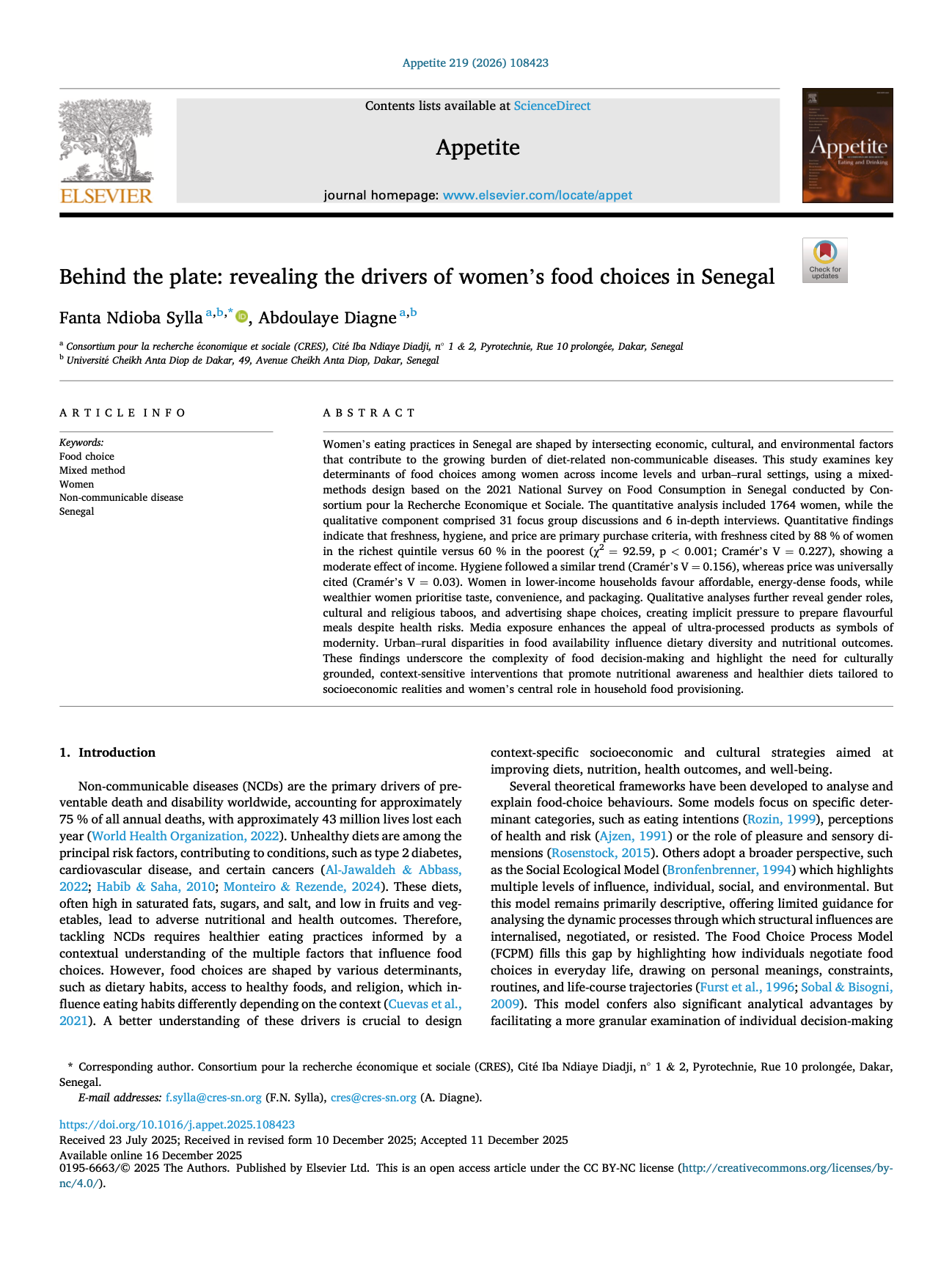
Behind the plate: revealing the drivers of women's food choices in Senegal
PUBLIÉ LE : 20 octobre 2026
The food choices of women in Senegal are influenced by economic, social, cultural and environmental factors that impact the quality of diets and the risks of diet-related non-communicable diseases. In this article published in the scientific journal Appetite, Fanta Ndioba Sylla and Abdoulaye Diagne, researchers at the Consortium for Economic and Social Research (CRES), analyze the main determinants of women's food choices, taking into account income differences and urban and rural contexts.
Fichier disponible
CITATION
Article Scientifique. 2026. Behind the plate: revealing the drivers of women's food choices in Senegal.
The food choices of women in Senegal are influenced by economic, social, cultural and environmental factors that impact the quality of diets and the risks of diet-related non-communicable diseases. In this article published in the scientific journal Appetite, Fanta Ndioba Sylla and Abdoulaye Diagne, researchers at the Consortium for Economic and Social Research (CRES), analyze the main determinants of women's food choices, taking into account income differences and urban and rural contexts.
The study is based on a mixed approach using data from the 2021 National Survey on Food Consumption in Senegal. The quantitative component covers 1,764 women, while the qualitative component is based on 31 group discussions and six in-depth interviews. This approach makes it possible to examine both food purchasing criteria and the role of social norms, gender relations and the food environment in household decisions.
The results show that freshness, hygiene and price are among the main selection criteria. However, priorities vary according to income level: women from less well-off households give greater priority to affordable and energy-dense foods, while those from wealthier households attach greater importance to taste, practicality and packaging. Social expectations related to meal preparation, cultural and religious taboos as well as advertising also influence eating practices. Exposure to the media can in particular reinforce the appeal of ultra-processed products, sometimes associated with modernity. Differences in access to food between urban and rural areas also contribute to differences in dietary diversity.
The article thus highlights the complexity of food decisions and the need to promote interventions adapted to the socio-economic and cultural realities of populations. It provides useful elements for public decision-makers, researchers and nutrition and public health stakeholders to design actions promoting healthier diets, while taking into account the central role of women in the household food supply.
Scientific reference: Sylla, F. N. and Diagne, A. (2026). Behind the plate: revealing the drivers of women's food choices in Senegal. Appetite, 219, 108423. https://doi.org/10.1016/j.appet.2025.108423