Does Corruption Erode Institutional Trust? Micro-level Evidence from Sub-Saharan Africa
PUBLIÉ LE : 02 novembre 2026
Citizens’ trust in public institutions is essential to their legitimacy and effective functioning. In Sub-Saharan Africa, where perceptions of corruption remain a major concern, understanding how corruption affects institutional trust is particularly important for governance and the relationship between citizens and public authorities.
CITATION
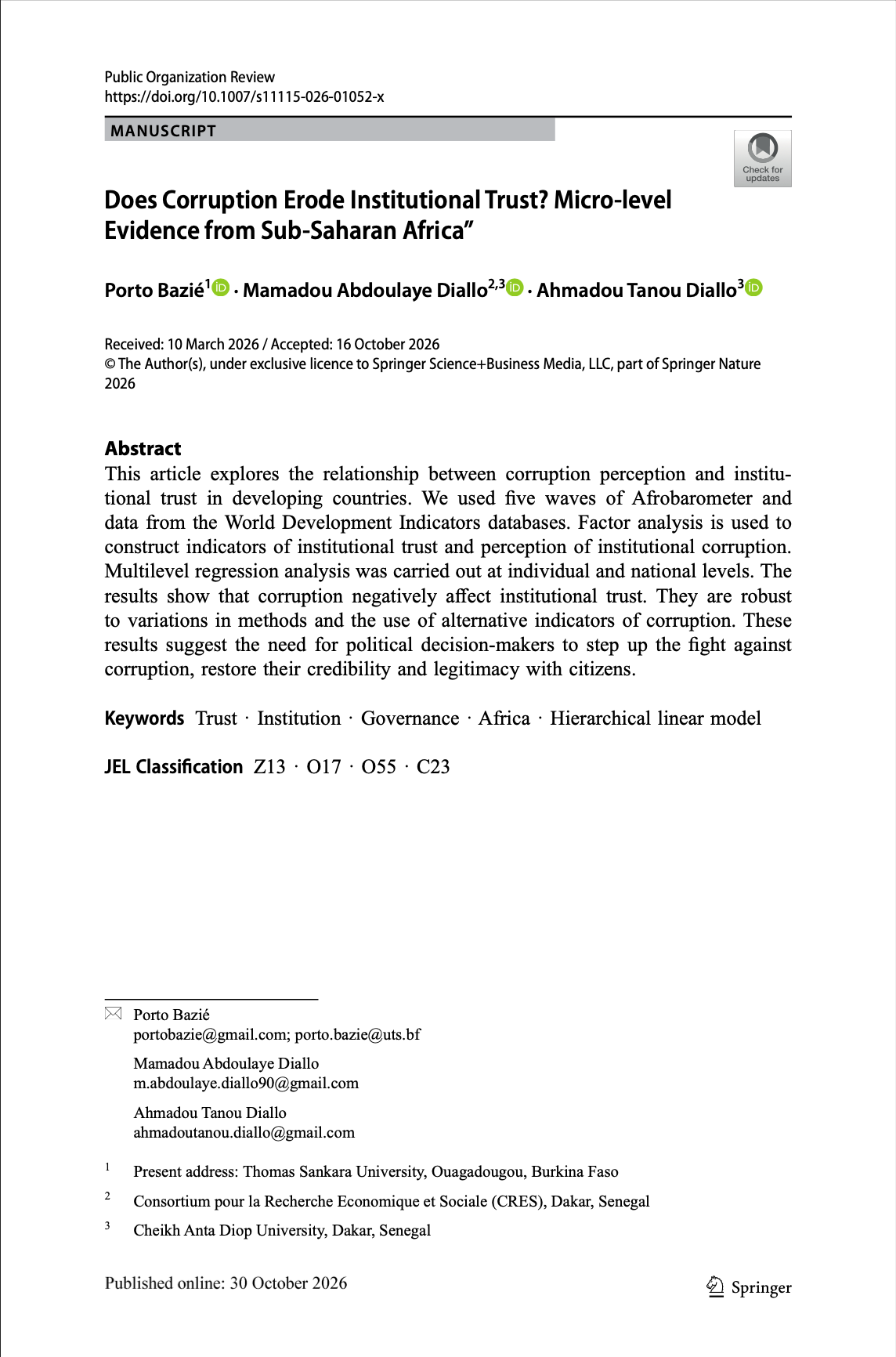
Article Scientifique. 2026. Does Corruption Erode Institutional Trust? Micro-level Evidence from Sub-Saharan Africa.
Does Corruption Erode Institutional Trust? Micro-level Evidence from Sub-Saharan Africa
Authors: Porto Bazié, Mamadou Abdoulaye Diallo and Ahmadou Tanou Diallo
Journal: Public Organization Review (2026)
DOI: https://doi.org/10.1007/s11115-026-01052-x
Description
Citizens’ trust in public institutions is essential to their legitimacy and effective functioning. In Sub-Saharan Africa, where perceptions of corruption remain a major concern, understanding how corruption affects institutional trust is particularly important for governance and the relationship between citizens and public authorities.
In this article, Porto Bazié, Mamadou Abdoulaye Diallo and Ahmadou Tanou Diallo examine the relationship between perceived corruption and citizens’ trust in institutions across Sub-Saharan Africa. The study draws on data from the five most recent rounds of Afrobarometer surveys (Rounds 5 to 9), complemented by data from the World Bank and the Quality of Governance database. It covers a sample of 108,123 individuals across 24 countries and uses factor analysis and multilevel regression models to account for both individual characteristics and country-level contexts.
The findings reveal a negative relationship between corruption and institutional trust. Perceptions of increasing corruption, perceptions of corruption within public institutions, and direct experiences of corrupt practices are all associated with lower levels of citizens’ trust. The study also highlights the role of factors such as institutional performance, educational attainment and place of residence in shaping institutional trust. The findings remain robust across different methodological specifications and alternative corruption indicators.
The authors conclude that public authorities need to strengthen anti-corruption efforts, improve the performance of public institutions and deliver on their commitments to citizens. These measures are essential to restoring institutional credibility and reinforcing public trust and legitimacy.
Access to the article
Read the article in Public Organization Review:
https://doi.org/10.1007/s11115-026-01052-x