Income and food price shocks, urban food security, and dietary deprivation: Evidence from Dakar, Senegal
PUBLIÉ LE : 03 novembre 2026
Food security and diet quality are particularly vulnerable to economic shocks in urban areas, where households depend heavily on markets for their food supplies. In Dakar, the COVID-19 pandemic combined declining household incomes with rising food prices, increasing the risk of food insecurity and dietary deprivation. Understanding how households respond to these shocks is essential for designing effective policies to protect vulnerable populations.
CITATION
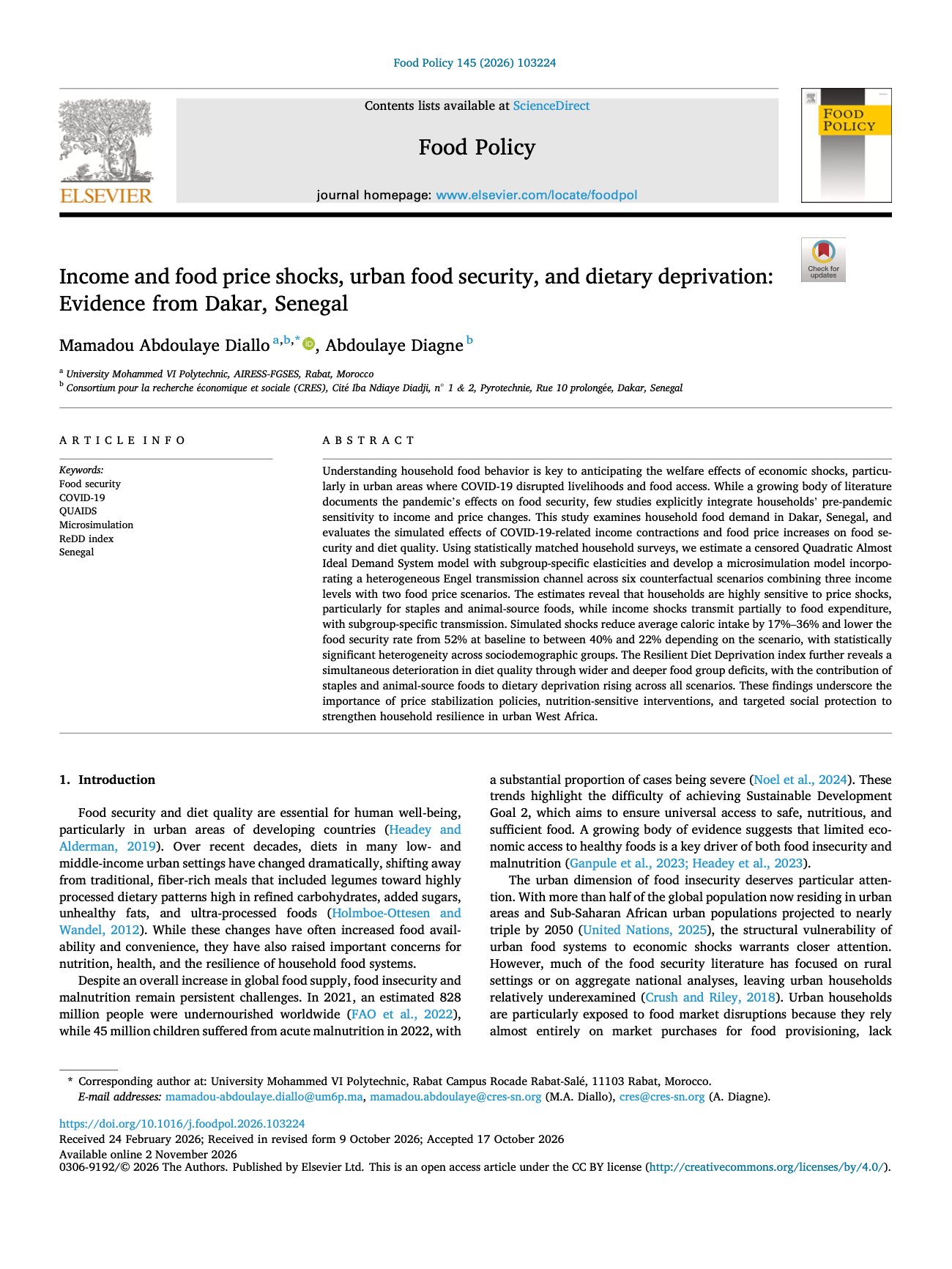
Article Scientifique. 2026. Income and food price shocks, urban food security, and dietary deprivation: Evidence from Dakar, Senegal.
Authors: Mamadou Abdoulaye Diallo and Abdoulaye Diagne
Journal: Food Policy, Volume 145 (2026), Article 103224
DOI: https://doi.org/10.1016/j.foodpol.2026.103224
Description
Food security and diet quality are particularly vulnerable to economic shocks in urban areas, where households depend heavily on markets for their food supplies. In Dakar, the COVID-19 pandemic combined declining household incomes with rising food prices, increasing the risk of food insecurity and dietary deprivation. Understanding how households respond to these shocks is essential for designing effective policies to protect vulnerable populations.
In this article, Mamadou Abdoulaye Diallo and Abdoulaye Diagne examine the sensitivity of urban household food demand to income and food price changes in Dakar, Senegal, and assess the potential effects of COVID-19-related economic shocks on food security and diet quality. The study combines data from two household surveys: the CRES/COVID-19 survey conducted in 2021, covering 640 households, and the 2018/19 Harmonized Survey on Household Living Conditions (EHCVM). Using a statistical matching procedure, the authors estimate a censored Quadratic Almost Ideal Demand System (QUAIDS) model and develop a microsimulation framework to assess six scenarios combining different levels of income contraction and food price increases.
The findings show that households are particularly sensitive to food price increases, especially for staple foods and animal-source products. Depending on the simulated scenario, average caloric intake declines by 17% to 36%, while the food security rate falls from approximately 52% at baseline to between 40% and 22%. The study also highlights significant differences in the effects of these shocks across socioeconomic groups, with poorer households experiencing particularly severe consequences. Furthermore, the Resilient Diet Deprivation (ReDD) index reveals a deterioration in diet quality, with wider and deeper nutritional deficits across food groups.
The authors emphasize the importance of combining price stabilization measures, nutrition-sensitive interventions and targeted social protection programmes to strengthen the resilience of urban households. In particular, they highlight the need to protect access to essential food commodities, support more diverse and nutritious diets, and extend social protection to households exposed to income and price volatility.
Access to the article
Read the article in Food Policy:
https://doi.org/10.1016/j.foodpol.2026.103224